Dryad Woman Cross Stitch Pattern PDF
A Forest Spirit That Demands Respect—Not Just a Pretty Face
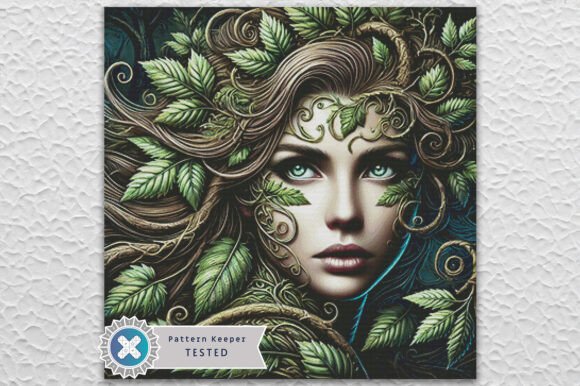
First impression? This isn’t a dainty woodland sprite. The Dryad Woman Cross Stitch Pattern PDF arrives with quiet gravity—a full-coverage, 350×350-stitch composition that feels like stepping into an ancient grove at twilight. Her pose is grounded, her hair woven with vines and moss, her expression serene but unyielding. There’s no cutesy simplification here: the shading in her bark-textured arms, the layered foliage behind her shoulders, the subtle gradation across 70 DMC thread colors—it all signals this was made for stitchers who treat cross stitch like visual storytelling, not just counting.
Where It Lives Best: Real Projects, Not Just Frames
I tested this pattern as the centerpiece for a limited-run embroidered tote bag line—organic cotton canvas, 14-count fabric, finished at 25×25 inches. The scale worked beautifully: large enough to command attention without overwhelming the bag’s structure. Customers responded immediately—not just to the “nature theme,” but to how *real* it felt stitched. One buyer wrote, “It looks like it grew there.” That’s the power of a design with intentional negative space, thoughtful color transitions, and balanced stitch density: it reads as handmade, not printed.
It also translated well onto a linen pillow cover (16-count), where the tighter grid softened fine details just enough to keep them legible. For baby items? I’d hold off—while the subject is gentle, the sheer number of small leaf clusters and vine tendrils makes it better suited for nursery wall art than a onesie or burp cloth. Same goes for caps or curved surfaces: the symmetry and central focus mean it’ll distort if forced onto a rounded crown or tight brim.
What You’ll Need to Know Before Cutting Thread
- Hoop size matters. At 350 stitches wide, you’ll need at least a 10-inch hoop—or plan for frequent repositioning. Don’t try to cram this into a 4-inch frame and expect clean tension.
- Fabric texture changes everything. On smooth linen? Crisp lines, rich depth. On slubby burlap or heavily textured duck cloth? Some delicate vine edges will blur. Test on scrap first—especially if you’re planning sweatshirt embroidery or custom apparel where fabric nap varies batch to batch.
- Dark backgrounds demand contrast checks. With 70 thread colors, it’s easy to assume “it’ll pop.” But several mid-tone greens and greys sit quietly against charcoal or navy. Run a black-and-white mockup to spot low-contrast zones before stitching your final piece.
- Washability isn’t automatic. Dense fill areas (like the trunk behind her back) trap moisture and stress threads over time. If this is going on a tea towel or kitchen apron meant for frequent laundering, reinforce those zones with a light tear-away stabilizer—and skip the satin stitch accents (not part of this pattern, but tempting to add).
Commercial Use? Yes—But Mind the Boundaries
As a craft business owner or Etsy seller, the Dryad Woman Cross Stitch Pattern PDF is a strong digital product: evocative, niche-appropriate, and visually distinct from mass-market florals or generic fairies. It fits cleanly into branding for botanical apothecaries, slow-living boutiques, or eco-conscious gift shops. But remember—this is a cross stitch pattern, not a machine embroidery file or applique design. If you’re listing finished embroidered patches or sweatshirt embroidery, clarify that clearly in your product description. Buyers expecting a .dst or .pes file will be disappointed.
More importantly: confirm licensing. The listing says “Full Coverage Cross Stitch Pattern for Advanced Stitchers”—but doesn’t state whether finished-item resale is permitted. As a designer, I never assume. I email the creator before listing any physical product using it—even a single pillow cover in my shop. Clarity protects your reputation and your customers’ trust.
Design Notes Every Embroiderer Should Try
- Stitch a 3×3 inch corner section on your target fabric first—check how the smallest leaves read at actual scale.
- Lay out all 70 DMC threads side-by-side under natural light. Group similar tones (e.g., six shades of olive) to spot potential blending issues.
- Print a grayscale version. Does the composition still hold weight? If it flattens into a muddy silhouette, adjust contrast in your stitching—maybe deepen shadows or lift highlights with metallic or variegated floss.
- Compare it on both light and dark fabric swatches. A design this detailed can feel heavy on black—but unexpectedly luminous on cream or oat.
- Ask yourself: does this elevate the *product*, or just fill space? On a holiday gift pillow? Yes. On a minimalist apron meant for daily use? Maybe not—its richness competes with function.
Final Thought: It’s Not for Everyone—And That’s Its Strength
The Dryad Woman Cross Stitch Pattern PDF won’t suit quick craft kits, beginner samplers, or products needing bold, scalable simplicity. But for designers building intentional collections—handmade product lines rooted in myth, nature, and quiet strength—it’s a rare find. It earns its place on a boutique shelf, in a personalized wedding gift (think: framed heirloom for a forest ceremony), or as the soul of a small shop’s seasonal collection. It doesn’t shout. It waits—then lingers. And in a market flooded with fast, forgettable designs, that kind of presence is worth every counted stitch.